By Trudi-Rose Edwards
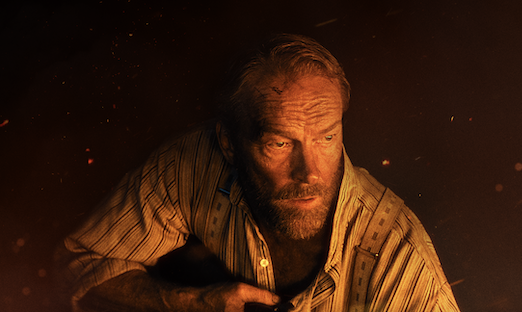
First-time director Julien Hayet-Kerknawi told the audience at the London premiere of The Last Front that it took eight years to make the film. This makes sense, it’s a film jam packed with stunning scenery shots, action set pieces and countless cannon-fodder extras; a labour of love.
Set in 1914 Belgium, The Last Front is ultimately a war film and not an easy sell these days. In contrast to the more ‘typical’ WW1 film, The Last Front doesn’t focus on trench life, rather the attempts to liberate a small Belgian farming community from a German platoon that has descended upon it.

Leading the resistance is Game of Thrones’ Iain Glen who plays Leonard Lambert a widower farmer who is something of a pacifist. He runs his farm with the help of his son Adrien (James Downie, decent) and daughter Joanna (Emma Dupont, a little wooden) and is a highly regarded member of the local community. Leonard’s counterpart is German army officer, Lieutenant Laurentz (played fantastically by Joe Anderson), a trigger-happy, drunken psychotic who spends the majority of the film mercilessly killing anyone and everyone who stands in his way.

For the most part, this slightly different take on a war epic works, however you’ll have to overlook the first fifteen minutes which are slow, a little dreary and feature some of the weakest acting of the film (was it filmed chronologically? Some characters feel like they’re still warming up, rehearsing even.) The exceptions are Iain Glen who is ultimately the heart of the show and does a lot of the emotional lifting, and Joe Anderson whose pure evilness eclipses anything you’ll see in a bigger budget blockbuster. There’s also David Calder who plays the local priest and whose decades of experience shine through, despite only having a small role.
Luckily, once the action kicks in – and it really does – the cringe emoting and wooden deliveries play second fiddle to the drama. One thing the film does fantastically well is build up a real sense of tension, from the opening scenes where the ever-nearing threat of the German army is palpable to later escape scenes that are laced with impending doom. This is all helped by the score, which is an absence of music more than anything; sounds and noise rather than the more traditional movie score, something that works extremely well.

One gripe about the actions scenes is that, at times, they have an air of a first-person shooter video game; characters ducking around corners, guns reloaded behind flimsy cover, pot shots being taken from the top of church windows. Whilst this is no doubt how a village might defend itself, the execution was a little cartoonish in places.
With all this in mind, The Last Front is certainly an entertaining watch. We’re given just enough time to care about the characters. The enemy – not that an opposition army needs an evil lieutenant to be frightening – is appropriately horrific, and the frenetic, suspenseful action scenes are contrasted with some beautiful visuals of the natural surroundings.
It is let down by some of the supporting roles and the lack of any real kind of ‘twist’; it’s all rather movie-by-numbers but the departure from soldiers in the trenches really makes The Last Front a war epic worth watching.
The Last Front is in UK cinemas from November 1st