By Trudi-Rose Edwards
★ ★ ★ ★
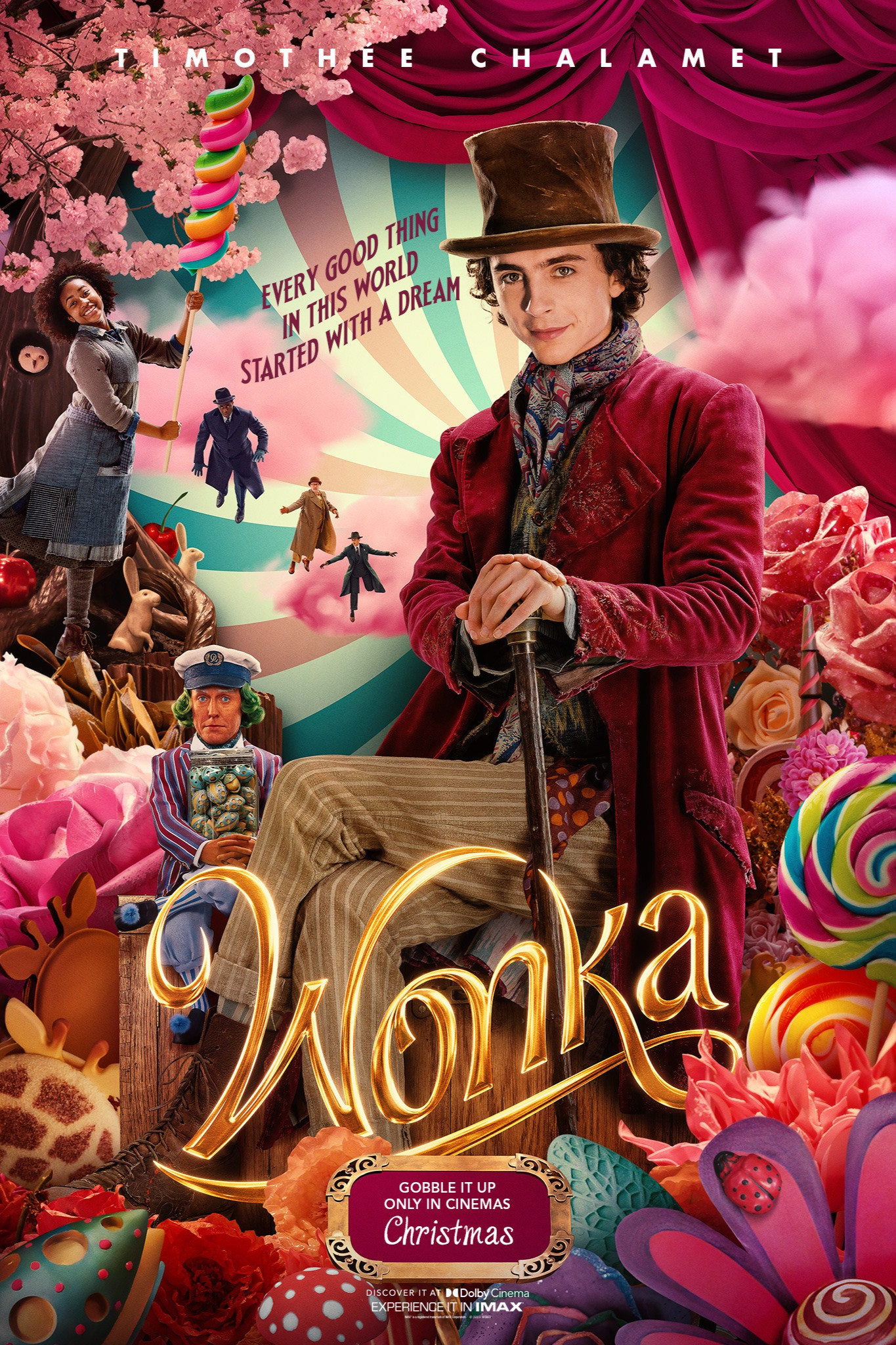
Willy Wonka, Roald Dahl’s eccentric chocolate factory owner has been a favourite of children and adults alike for almost 50 years. He made his first appearance in the 1964 children’s novel Charlie and the Chocolate Factory and in 1971 was portrayed by the late Gene Wilder in the classic film adaptation Willy Wonka & the Chocolate Factory in what is often considered the actor’s greatest role. Then, in 2005 Johnny Depp gave his own, rather polarising, portrayal of the famed chocolatier in Charlie and the Chocolate Factory.
Everyone has their favourite version of Wonka, some love the whimsy character of the book, others consider Wilder the quintessential Wonka (although Dahl wasn’t keen) and there are fans of Depp’s child-like weirdness too. But now, thanks to Paul King’s (director of the wonderful Paddington films) Wonka, another contender enters the fray in the lanky shape of Timothée Chalamet.
If you’ve grown tired of golden tickets, Charlie Bucket and factory shenanigans then Wonka is the film for you. In a vein similar to Marvel superheroes, Willy gets his own origin story movie where we learn…well, not that much actually. Fresh off the boat from somewhere Willy arrives at a vaguely European city with the intention of opening a chocolate shop. There, that’s it, that’s the premise. At this point, young Willy has already developed a number of chocolatey delights – how he created them remains a mystery – and has already visited the fabled Loompa Land (more on this later).
Luckily (for viewers, less so for Willy) the city’s confectionary business has been monopolised by the crooked chocolate cartel of Slugworth, Prodnose and Fickelgruber (Paterson Joseph, Matt Lucas and Matthew Baynton respectively) who go above and beyond to block Willy from opening his shop. To make matters worse, Willy gets conned into working in a laundry room to pay off his lodging debts by a very Dickensian (or maybe just Dahl-esque) landlady played by Olivia Colman who spends most of the film gurning at the camera in a role that her The Crown sister Helena Bonham Carter might have made better use of had she not already played Mrs Bucket in the 2005 film.
One quibble is the relative lack of chocolate. For a film focused on opening a chocolate shop there isn’t much to get the mouth watering. The chocolate Willy peddles to customers on his first day in the city look like a kind of colourful CGI creation from outer space, hardly a Whipple-Scrumptious Fudge-Mallow Delight. Cast your mind back to the opening credits of the 1971 film and you’ll find more chocolatey treats there than in the whole of Wonka’s two hour runtime.
The plot cranks up a gear when Willy and his new laundry friends begin their covert operations to get his chocolate shop open. What follows is the kind of mischief families have come to love from the Paddington films; cunning plans to break out of the laundry room, heading to the zoo to milk a giraffe (yes, really), and gatecrashing a funeral (played for laughs, obviously) to infiltrate the cartel’s inconveniently located HQ beneath the city’s cathedral.
If you thought that sounded fun enough don’t forget the fact that this film is very much a musical. No more than ten minutes seem to pass before another melody kicks in and we’re swept away into another perfectly choreographed, toe-tapping bonanza. The songs are fun in the moment, and passably sung by Chalamet, but sadly forgettable – I guarantee the only tune you’ll be humming after watching the movie will be Pure Imagination made famous in the original 1971 movie. The rest, despite the wonderful production value for each number, fade into obscurity.
Thankfully, the mediocre songs are balanced out by a sharp and witty script. There are several callbacks to the 1971 film, and not all of them obvious, that will excite fans of the original movie and when a film is stacked with more top comedic talent than the Apollo, laughter isn’t hard to come by. Particularly funny is Keegan-Micheal Key’s incompetent Chief-of-Police and, of course, Hugh Grant’s much anticipated turn as an Oompa Loompa. Grant threatens to steal every scene in his small role as Lofty the Oompa Loompa, CGI’d down to four feet tall and sporting an orange face and green hair-do to resemble the 1971 Loompas.
One thing is very clear throughout, Chalamet’s Willy Wonka isn’t one of his own creating similar to Johnny Depp’s 2005 incarnation. From the outfits to the dialogue, this Willy Wonka is absolutely meant to be a younger version of Gene Wilder’s Wonka, something that both helps and hampers Chalamet’s performance. Knowing that he is the same Wonka the vast majority of viewers know and love make all the nods to Wilder all the more endearing but at the same time, Chalamet doesn’t have the dark edge required nor the easy charisma to convincingly pull off an homage. Lines taken directly from the 1971 film – “Scratch that. Reverse it.” – fall flat and come off as more of an impersonation. Chalamet instead excels in the more emotional moments and in showing off young Wonka’s earnest and often naïve side. Despite this is seems hard to believe that he would later become the reclusive, slightly sinister eccentric seen in Willy Wonka & the Chocolate Factory.
Overall there’s no denying Wonka is a wonderful, family-fun adventure that manages to be sweet but not saccharine. Chalamet is a fine Willy Wonka so long as you don’t dwell too much on Gene Wilder’s performance; the production – especially during musical numbers – is gorgeous; and the movie is filled with famous faces from both sides of the pond who by and large give memorable, rib-tickling performances that will delight families and sweeten even the sourest of moods.
Released on 8 December in the UK